
Aviation accounting software

Aviation Accounting Software Connected to the Work Behind the Numbers

Aviation accounting becomes difficult when finance has the financial record but not the operational story behind it.

A maintenance event consumes parts and labor.

Purchasing creates vendor expenses.

Inventory transactions affect cost and valuation.

MRO work creates billing requirements.

Flight and workforce activity influence financial performance.

When those records live in separate systems, finance spends time collecting, reconciling, and explaining information before it can analyze it.

MISA aviation accounting software connects financial processes with the operational activity that creates the transactions.

Accounting Is Built Into MISA

Accounting is not a separate add-on to the MISA platform.

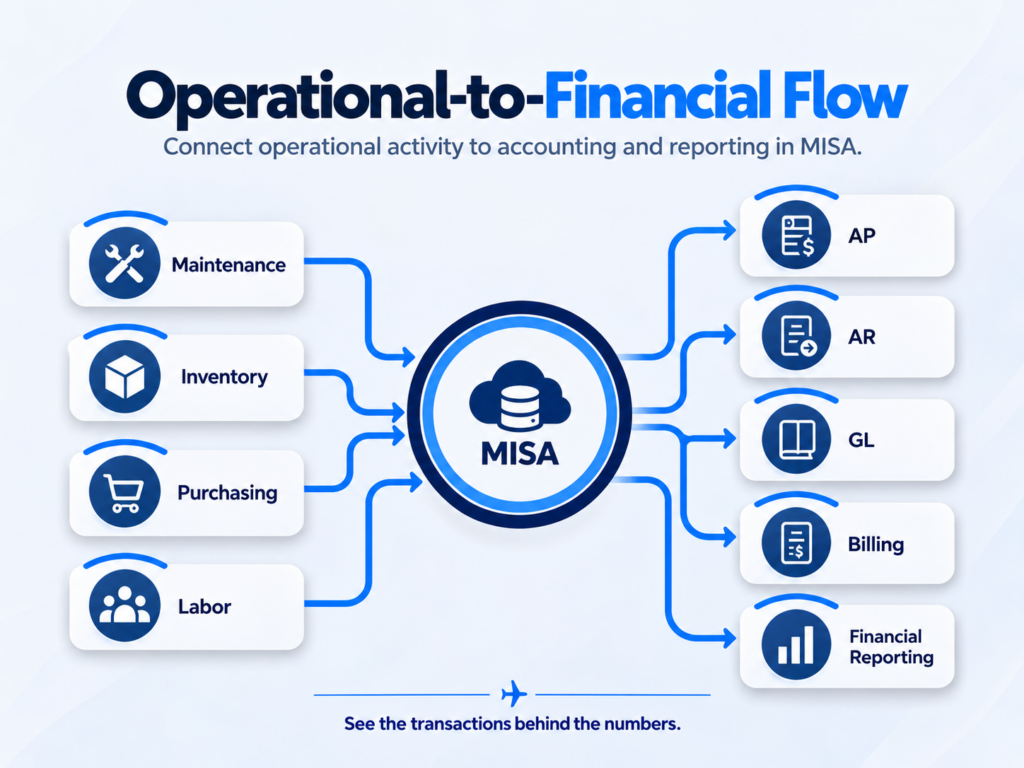
Accounts payable, accounts receivable, general ledger activity, purchasing, inventory, maintenance, labor, and operational workflows work within the same broader environment.

As employees perform operational work, the underlying information becomes available throughout the system for reporting and analysis.

That reduces the need to reconstruct financial context from separate spreadsheets, departmental reports, and disconnected applications.

01

Understand the Transactions Behind the Numbers

A financial total can tell management what was spent. It does not necessarily explain why.

Because MISA connects operational and financial information, finance teams can investigate activity in greater detail. Depending on the transaction, that may include information related to:

  • Aircraft or fleet
  • Parts usage
  • Maintenance activity
  • Labor
  • Purchasing
  • Vendor expense
  • Operational activity
  • Date and cost information

This gives finance teams greater context when analyzing costs, researching variances, supporting budgeting and forecasting, or answering questions from leadership.

02

Accounts Payable Connected to Purchasing

Many vendor expenses begin outside accounting.

A maintenance requirement may create a purchase.

A component may be sent for outside repair.

Inventory may need replenishment.

MISA's purchasing functionality operates alongside accounting and supports purchases, repairs, warranties, and vendor activity.

That gives accounts payable greater access to the operational context surrounding vendor obligations rather than receiving the invoice as an isolated financial event.

03

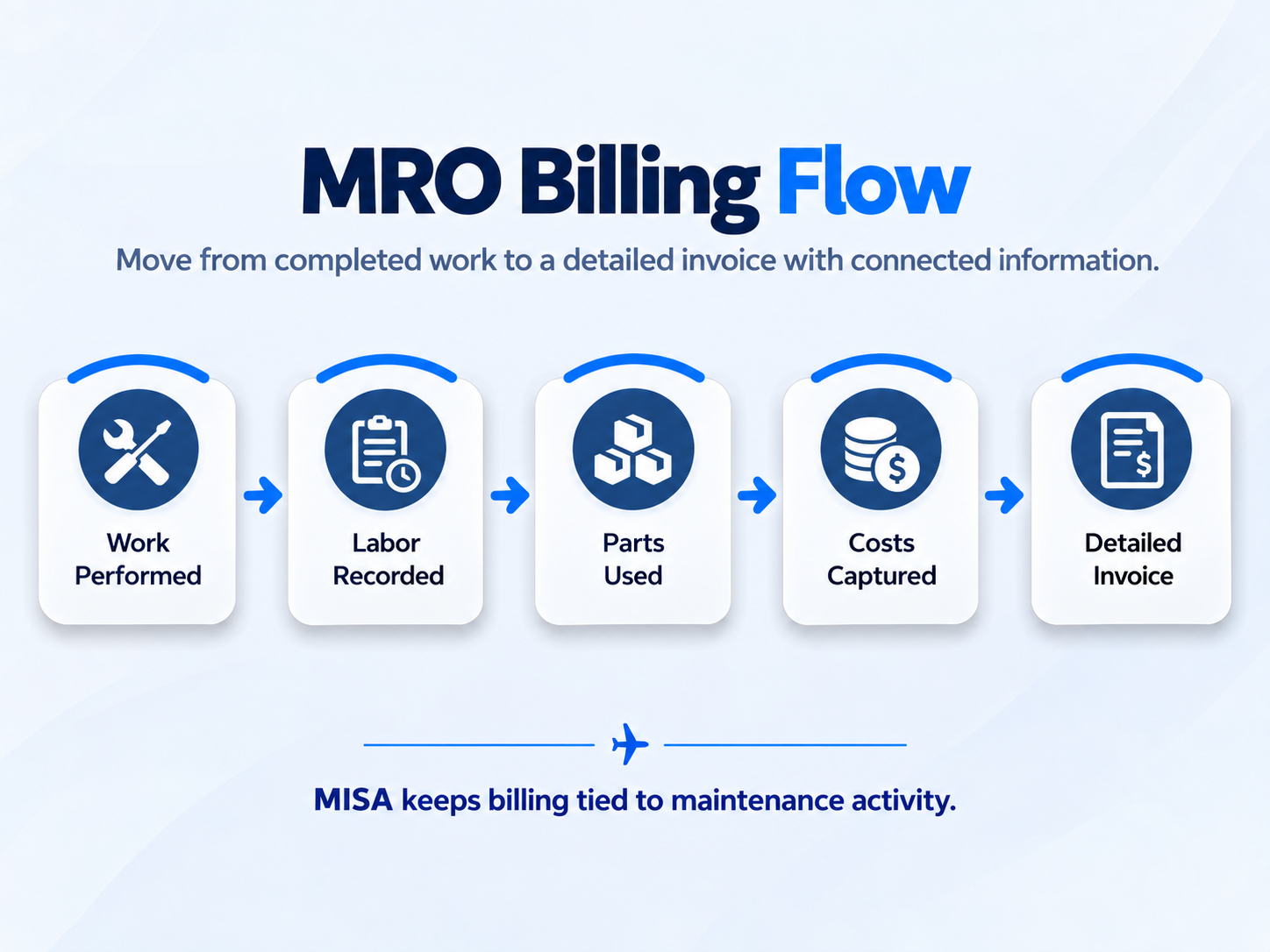
Accounts Receivable and MRO Billing

For MROs, the financial record depends heavily on the maintenance record.

Labor, parts, repairs, work-order activity, and other costs may all contribute to the work being billed.

MISA connects those activities and supports detailed maintenance invoicing.

For organizations evaluating MRO accounting software, this connection is critical.

Billing should not require teams to manually reconstruct the maintenance event from multiple systems after the work is complete.

MISA helps keep the operational activity and financial information closer together.

04

Streamline Maintenance Billing

Searches for automated maintenance billing, aviation billing software, and aircraft maintenance billing software often reflect the same underlying problem:

Too much manual work is required to move from completed maintenance to an accurate invoice.

MISA helps streamline that process by connecting maintenance work with parts, labor, purchasing, cost, and billing information.

The objective is not simply to produce an invoice faster.

It is to make the source information behind the invoice more complete and traceable.

That gives billing and finance personnel stronger support for understanding what is being charged and why.

05

Financial Reporting Built on Connected Information

MISA provides standard financial reports including:

  • Income statements
  • Balance sheets

It also supports custom reporting for an organization's financial and operational requirements.

Because the reporting data comes from the same broader system used for operational activity, finance teams can spend less time gathering information from multiple departments before analysis can begin.

That can improve the consistency of reporting while providing easier access to the detailed transactions behind summary results.

06

Support Budgeting and Forecasting With Better Inputs

Budgeting and forecasting depend on reliable historical and current information.

When accounting, maintenance, inventory, purchasing, labor, and operational records are disconnected, finance may spend significant effort preparing the data before it can use it.

MISA brings those information sources together.

The system does not replace the financial judgment required for forecasting.

It provides finance teams with connected operational and financial information they can use as an input to budgeting, forecasting, variance analysis, and management planning.

07

Aviation Accounting for Government Contract Work

MISA also includes accounting structures designed to support government aviation contracts.

The system can track:

  • Contract
  • ACRN
  • CLIN
  • Individual work performed
  • Related cost information
  • Billing information

This information can support creation of a Contract Funds Status report.

For aviation organizations working under government contracts, that creates a clearer relationship between work performed, costs incurred, and contract reporting requirements.

Give Finance the Operational Context It Needs

Aviation finance should not have to reconstruct the operation after the fact.

MISA connects accounting with maintenance, inventory, purchasing, labor, and operational activity so finance teams can work from a more complete view of the business.

See how MISA aviation accounting software connects financial transactions with the aviation activity behind them.

Frequently Asked Questions About MISA

Does MISA include accounts payable, accounts receivable, and general ledger functionality?

Yes. AP, AR, GL, purchasing, inventory, maintenance, labor, and operational activities work within the broader MISA system.

Yes. MISA supports detailed maintenance invoices and connects financial information with maintenance, parts, labor, and related activity.

MISA supports integrated workflows that can reduce manual work between maintenance activity and billing. Claims about a specific organization’s level of billing automation should be evaluated against its configured workflow.

MISA provides standard reports including income statements and balance sheets, along with customizable financial and operational reporting.

MISA can track contract, ACRN, CLIN, individual work, cost, and billing information and can support Contract Funds Status reporting.