
Aviation maintenance tracking software

Aviation Maintenance Tracking Software That Connects the Work to the Operation

Knowing that maintenance is due is only the beginning.

Maintenance teams also need to understand the work involved, the parts and labor required, aircraft status, upcoming requirements, and the costs associated with the activity.

MISA aviation maintenance tracking software brings those pieces together.

MISA combines maintenance planning, forecasting, and tracking with inventory, purchasing, labor, accounting, and operational information so teams can manage the work without isolating maintenance from the rest of the organization.

Move Beyond Recording Completed Maintenance

Traditional maintenance tracking can answer:

A more useful system should also help teams answer:

MISA combines maintenance planning, forecasting, and tracking within the broader aviation operation. That gives maintenance teams tools for managing the work while giving other departments access to the information that affects them.

01

Plan and Track Routine and Non-Routine Maintenance

Aviation maintenance does not consist of one predictable workflow. Organizations must manage both planned requirements and unexpected work.

MISA supports routine and non-routine maintenance activity while providing maintenance personnel and managers with a common environment for planning, forecasting, tracking, and oversight.

The goal is not simply to store completed maintenance records. It is to create better visibility into the work before, during, and after the maintenance event.

02

Connect Maintenance With Parts Availability

A maintenance requirement often creates an inventory requirement. If the needed part is unavailable, that quickly becomes a purchasing, repair, or vendor issue.

MISA connects maintenance with inventory and purchasing so teams can work from related information rather than building separate records for the same maintenance event.

Maintenance personnel gain better visibility into the resources supporting the work, while inventory and purchasing teams gain context around what is creating the demand.

03

Track Labor Against Maintenance Work

Labor is another critical part of maintenance execution and cost. MISA can track employee clock-in and clock-out time against specific maintenance tasks and work-order lines.

The system can also support different labor rates based on the user, job, work order, or line. Connecting labor with the work being performed provides useful information for:

  • Maintenance oversight
  • Cost analysis
  • Customer billing
  • Workforce planning
  • Contract reporting

Instead of reconstructing labor activity after the work is finished, the time record stays closer to the underlying maintenance activity.

04

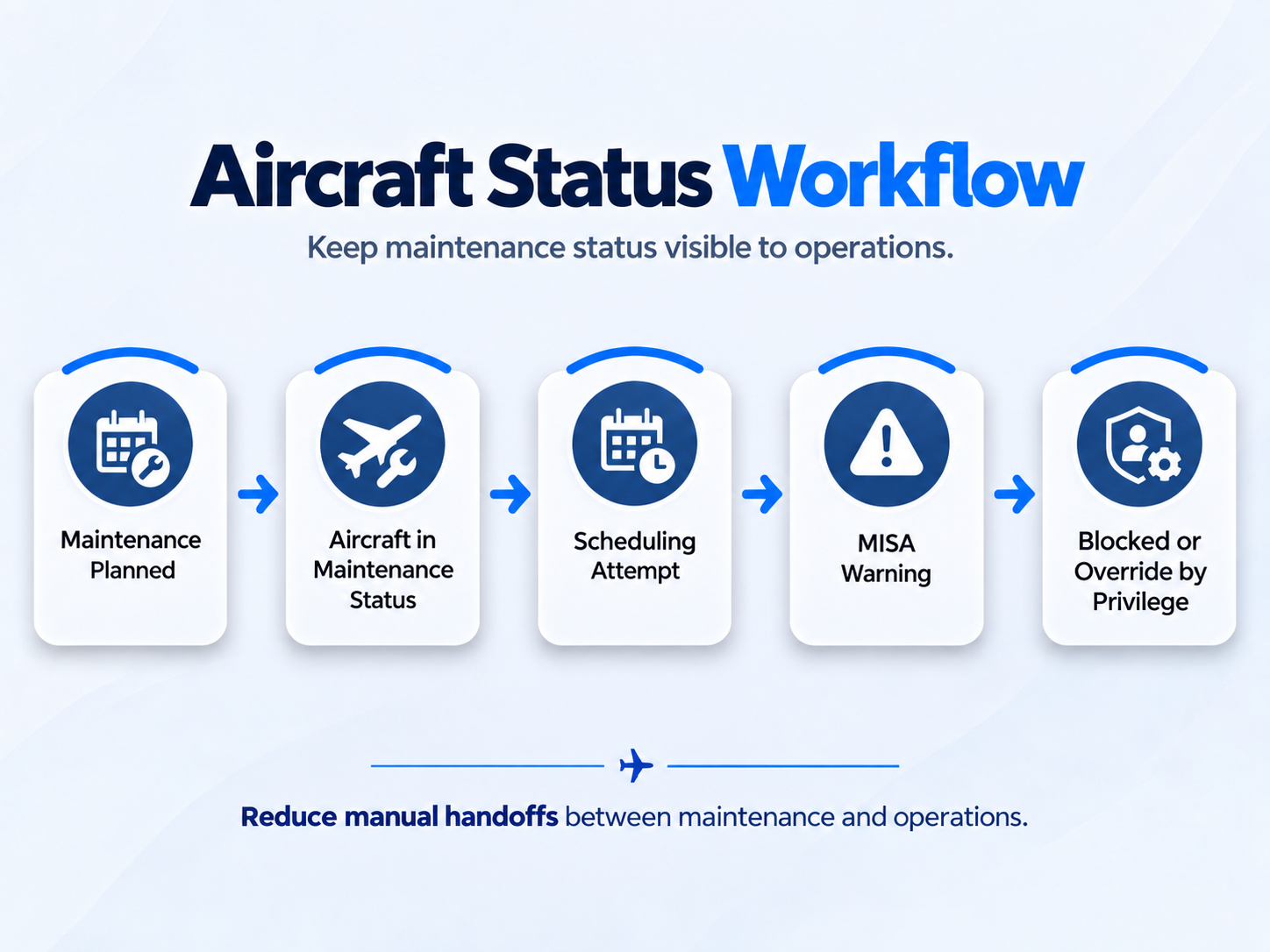
Keep Aircraft Maintenance Status Visible to Operations

Maintenance status affects more than the maintenance department. If an aircraft is unavailable, operations needs to know before it is assigned to a flight. MISA allows designated personnel to place an aircraft into maintenance status for a specified date and time period.

If someone attempts to schedule that aircraft during the maintenance period, the system displays a warning. Whether the scheduling action can continue depends on the user's assigned privileges.

That creates a direct connection between aircraft maintenance tracking software and operational scheduling. The maintenance status is not dependent on someone remembering to send an email or update another spreadsheet.

05

Connect Maintenance Activity With Financial Impact

Maintenance creates costs through parts, labor, repairs, purchasing, and vendor activity. MISA connects those operational transactions with financial information.

Managers can oversee maintenance costs and revenues, and the system supports detailed maintenance invoicing. This is particularly important for MROs, where the maintenance record and financial record are closely related.

Instead of waiting until the end of the work to reconstruct what happened financially, MISA helps maintain a connection among the work, the resources used, and the resulting costs.

06

Airline and MRO Maintenance Software in a Connected Environment

For an airline, maintenance status can directly affect aircraft availability and operational planning.

For an MRO, maintenance activity can affect parts, labor, purchasing, customer billing, and financial performance. For a government contractor, the same activity may also need to support contract-specific cost and reporting requirements.

Those needs are different, but they share one requirement:

Maintenance information has to move beyond the maintenance department.

MISA is designed around that connection.

From Maintenance Tracking to Operational Visibility

A maintenance tracking system can tell you that a task exists.

A connected maintenance environment can help teams understand:

What needs to happen, what resources support it, what aircraft it affects, and what the work costs.

That is the role MISA is designed to fill.

See how SkedFlex MISA connects maintenance planning and tracking with inventory, purchasing, labor, aircraft status, and financial information.

Frequently Asked Questions About MISA

What maintenance capabilities does MISA provide?

MISA combines maintenance planning, forecasting, and tracking and supports both routine and non-routine maintenance activity.

Yes. Maintenance and inventory are part of the same broader system, making it easier to connect maintenance requirements with parts availability and purchasing activity.

Yes. MISA can track employee time against specific maintenance tasks and work-order lines and supports different labor rates based on the user, job, work order, or line.

Yes. Authorized users can place an aircraft in maintenance status for a specified period. Attempts to schedule the aircraft during that period generate a warning, with override capability controlled by user privileges.

No. Maintenance is part of the larger MISA aviation ERP software environment connecting inventory, purchasing, accounting, labor, HR, flight operations, and other business functions.